The Fall of the Turkish Model: How the Arab Uprisings Brought Down Islamic Liberalism by Cihan Tugal
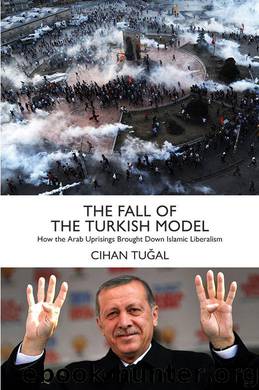
Author:Cihan Tugal
Language: eng
Format: mobi, epub
Publisher: Verso Books
Published: 2016-03-08T04:30:00+00:00
CHAPTER 4
The Revolt Against Authoritarian Liberalism
The events in Tunisia and Egypt in late 2010 and early 2011 were almost completely unexpected. Many self-styled clairvoyants retrospectively argued that they had foreseen the uprisings – claims that are open to ridicule.1 These explosive events created new realities and are not traceable to what was already known about these countries. Citizens’ orientations and national power blocs were deeply shaken over the span of a few weeks. However, whether these events would eventually lead to a durable transformation of sociopolitical structures depended on the existing balance of forces.2
Chapters 4, 5, and 6 will demonstrate that these revolts had twisted consequences due to the shape of political societies and power blocs (and their transnational interactions). Rather than resulting in revolutionary transformation, the uprisings rather dynamited the potentials for peaceful liberalization along the lines of the Turkish model (and ultimately the sustainability of the Turkish model in Turkey itself). They may also have planted the seeds of deeper structural transformations in the future, but that remains to be seen.
The Unforeseen Road to 2011
A series of street mobilizations spanning a decade paved the way for the 2011 revolt in Egypt. Since Islamists were building their muscles ‘under the radar’,3 most street politics had a non-Islamist face. Between 1998 and 2008, around 2 million Egyptian workers participated in more than 2,600 factory occupations. Joel Beinin points out that this mobilization ‘constitutes the largest and most sustained social movement in Egypt since the campaign to oust the British occupiers following the end of World War II’.4 The tension escalated after 2006, with more than 600 collective labour actions per year.5 Textile workers led the actions, but many workers from the private and public sectors, as well as white-collar workers and professionals (teachers, clerks, pharmacists, doctors and university professors) also participated. The actions protested low wages and the failure to pay bonuses following privatization, the establishment of free trade zones and the deregulation of employer–employee relations.6
The strikes were initiated by local workers’ networks: the union officials adamantly resisted them (and in some cases, they were themselves detained by workers).7 The strikes not only led to higher bonuses, but the first official recognition of non-regime unions. The workers’ movement had no national leadership either: liberal and leftist Cairo activists (such as the coalition group Kefaya) tried to build bonds with the striking workers, but these were short-lived. Workers’ economic actions became national in scope partly thanks to the brokerage of human rights and labour NGOs, as well as the efforts of leftist politicians. This broadening led, among other things, to a nationwide minimum wage campaign. But the NGOs and the politicians kept political demands out of their labour activities. Workers resisted outreach by some youth activists who directly pushed for the politicization of the labour movement.8
The media-savvy youth movement, a liberal democratic opposition, caught more of the international attention. The first leap forward of the liberal forces on the street was in protest against fraud during the 2005 elections.9 The protestors
Download
The Fall of the Turkish Model: How the Arab Uprisings Brought Down Islamic Liberalism by Cihan Tugal.epub
This site does not store any files on its server. We only index and link to content provided by other sites. Please contact the content providers to delete copyright contents if any and email us, we'll remove relevant links or contents immediately.
| Africa | Americas |
| Arctic & Antarctica | Asia |
| Australia & Oceania | Europe |
| Middle East | Russia |
| United States | World |
| Ancient Civilizations | Military |
| Historical Study & Educational Resources |
Cecilia; Or, Memoirs of an Heiress — Volume 1 by Fanny Burney(32561)
Cecilia; Or, Memoirs of an Heiress — Volume 2 by Fanny Burney(31958)
Cecilia; Or, Memoirs of an Heiress — Volume 3 by Fanny Burney(31944)
The Secret History by Donna Tartt(19098)
Sapiens: A Brief History of Humankind by Yuval Noah Harari(14392)
Leonardo da Vinci by Walter Isaacson(13339)
The Radium Girls by Kate Moore(12033)
Sapiens by Yuval Noah Harari(5374)
How Democracies Die by Steven Levitsky & Daniel Ziblatt(5221)
The Wind in My Hair by Masih Alinejad(5100)
Homo Deus: A Brief History of Tomorrow by Yuval Noah Harari(4922)
Endurance: Shackleton's Incredible Voyage by Alfred Lansing(4786)
Man's Search for Meaning by Viktor Frankl(4608)
The Silk Roads by Peter Frankopan(4537)
Millionaire: The Philanderer, Gambler, and Duelist Who Invented Modern Finance by Janet Gleeson(4481)
The Rape of Nanking by Iris Chang(4218)
Joan of Arc by Mary Gordon(4116)
The Motorcycle Diaries by Ernesto Che Guevara(4105)
Stalin by Stephen Kotkin(3971)
